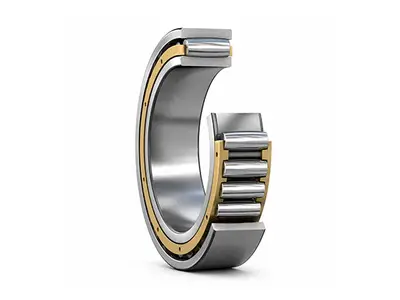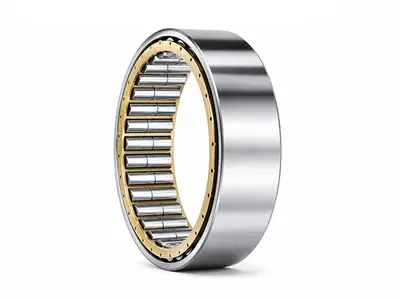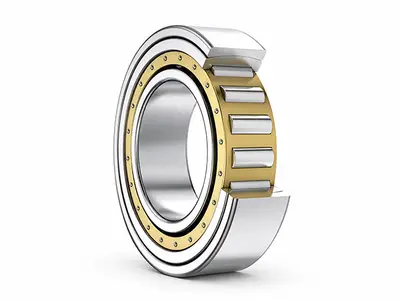
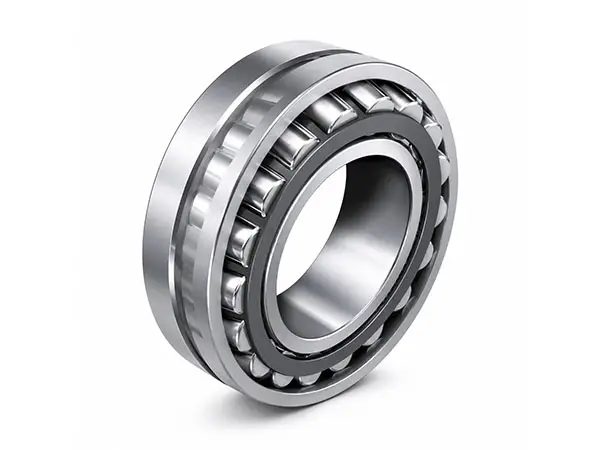
Spherical Roller Bearings
Self-Aligning Bearings for Heavy Radial and Vibration LoadsBearing Type: Spherical Roller Bearing
Series: 20000 Series
Bore Diameter: 150-1060 mm
Self-Aligning Angle: 1°-2.5°
Radial Load Capacity: High
Axial Load: Axial load in either one direction; not for pure axial load.
Technical Specifications
| Specification | Details |
|---|---|
| Bearing Type | Spherical Roller Bearing |
| Series | 20000 Series |
| Bore Diameter | 150-1060 mm |
| Self-Aligning Angle | 1°-2.5° |
| Radial Load Capacity | High |
| Axial Load | Axial load in either one direction; not for pure axial load |
| Speed Suitability | Lower limiting speed than cylindrical roller bearings |
| Material | GCr15 / GCr15SiMn / G20Cr2Ni4A |
| Basic Designs | C / CC / CA / TN1 |
| Cage Options | Pressed steel, machined solid or nylon molded |
| W33 Option | Lubrication-feature option available |
| Typical Duty | Heavy load, vibration and shaft deflection |
Spherical Roller Bearings Overview
Spherical roller bearings have two rows of rollers running on a common spherical outer-ring raceway. The center of curvature of the outer raceway coincides with the bearing center, allowing the inner ring, rollers and cage to align automatically relative to the outer ring.
The typical permissible misalignment is 1° to 2.5°, making the bearing suitable for shaft deflection, mounting misalignment and certain permanent angular-offset conditions. It carries high radial loads and axial load in either direction, but should not be used for pure axial loading.
Automatic Self-Alignment
The spherical outer raceway allows the bearing to compensate for angular errors without imposing severe edge stress on the rollers. This improves reliability where the shaft may bend or the bearing seats cannot remain perfectly aligned.
- Permissible misalignment of 1°-2.5°
- Compensates for shaft deflection
- Tolerates mounting misalignment
- Suitable for certain permanent angular offsets
Heavy-Load Designs and Cage Options
Close conformity between the spherical rollers and raceways provides high radial load capacity for heavy or vibration-loaded machinery. Because sliding and friction are higher than in cylindrical roller bearings, operating speed is generally lower. C, CC, CA and TN1 designs provide different ring, guide-ring and cage arrangements.
- High radial capacity under heavy loads
- Suitable for vibration-loaded machinery
- Multiple cage and guide arrangements
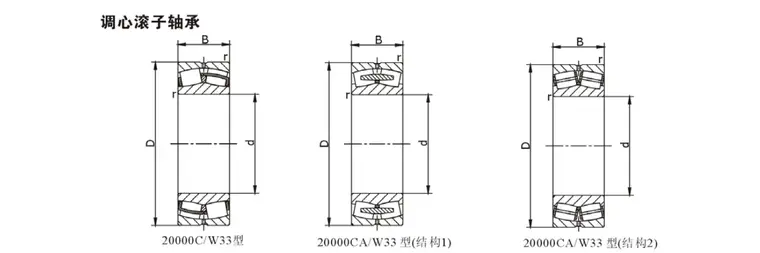
20000C/W33 and 20000CA/W33 structural configurations
20000 Series Structure Types
| Type | Configuration | Characteristics |
|---|---|---|
| 20000 C | Symmetrical spherical rollers; pressed-steel cage; no fixed inner-ring ribs; roller guidance by a floating guide ring | Long rollers, high load capacity and good self-alignment |
| 20000 CC | Optimized development of the C design | Reduced roller-raceway friction and increased load capacity |
| 20000 CA | Symmetrical rollers; machined solid cage; fixed small ribs and floating center guide ring | Ratings and limiting speed correspond to the matching CC design |
| 20000 TN1 | Symmetrical rollers with nylon molded cage; roller-guided design without fixed ribs or floating center ring | Lightweight cage option for optimized application |
Load and Speed Characteristics
Spherical roller bearings are particularly effective under heavy radial or vibration loads. They can accommodate axial load in either direction, but a supplementary thrust bearing is normally required when the axial component is especially large. Correct lubrication and speed selection are important because contact friction is relatively high.
Permissible misalignment : 1°-2.5°
Typical Applications
- Rolling mills
- Paper-making machinery
- Power transmission equipment
- Marine and ship machinery
- Heavy vibration-loaded equipment
- Deflected-shaft support positions
Available Models & Specifications
Click on any part number to view detailed CAD drawings and download PDF specifications.