
Raceway superfinishing is a common surface-finishing process for bearing rings. Finishing methods include superfinishing, polishing, barrel finishing, abrasive-belt grinding, and vibratory finishing. Raceway superfinishing is the final operation after raceway grinding. Under effective lubrication and cooling, usually with oil-based superfinishing fluid, a microcrystalline abrasive stone is pressed lightly against a rotating workpiece while rapidly oscillating through short strokes perpendicular to the direction of rotation. The stone follows the raceway's cross-sectional profile. To achieve better microscopic quality, the process is normally divided into rough and fine stages using stones of different grit sizes and different cutting parameters. Stone superfinishing significantly reduces surface roughness, improves raceway profile and waviness, and relieves internal stresses created by grinding. It forms a compressive-stress layer that improves contact-fatigue strength, lubricant-film quality, and corrosion resistance.
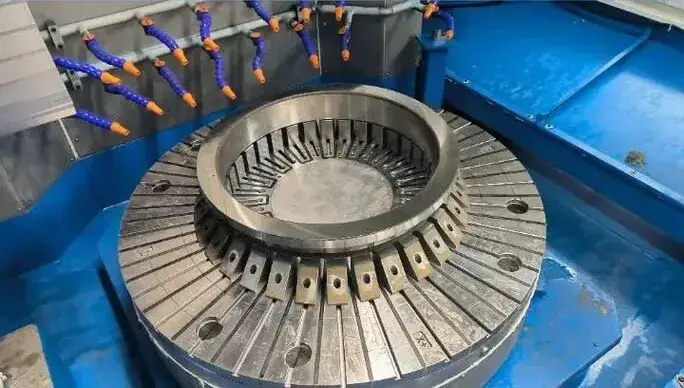
The quality of rolling surfaces directly affects bearing performance and life. Grinding uses relatively high stock-removal rates for productivity and is affected by machine accuracy, vibration, deformation, temperature, and cutting parameters. It therefore cannot always meet final raceway requirements directly. Critical measures such as roughness, waviness, geometric accuracy, and physical and mechanical properties of the surface layer require a subsequent finishing process. Its principal functions are:
Reducing Raceway Roughness
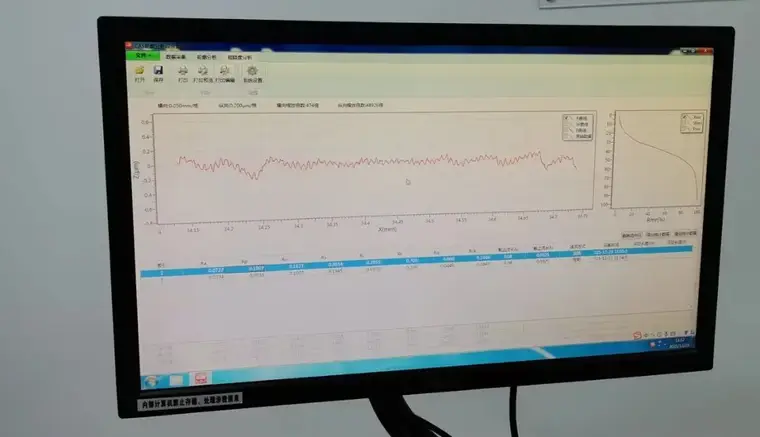
During superfinishing, the stone primarily cuts surface peaks without contacting valleys. When prior grinding quality is good, typical stock removal is 3-5 μm. Raceway roughness on heavy-duty bearings can be reduced to Ra 0.25 or Ra 0.4 or better. Lower roughness slows raceway wear, reduces friction, increases fatigue strength, and extends bearing life. It also improves resistance to corrosion and chemical attack.
Reducing Raceway Waviness
The stone makes area contact with the raceway, and its contact arc is longer than the wavelength of surface waviness. It therefore removes waviness peaks—on one side only, without affecting valleys—reducing vibration and noise at high speed.
Improving Raceway Profile
The stone oscillates and swings along the theoretical cross-sectional profile of the raceway. Fine abrasive action corrects local groove-shape errors by approximately 30%, improving load distribution and bearing capacity.
Creating a Compressive-Stress Surface Layer
Ground raceways often contain a low-hardness tensile-stress layer that can initiate fatigue spalling. Oscillating stone pressure during superfinishing produces residual compressive stress and a denser surface structure, improving resistance to fatigue and spalling.
Improving Lubricant-Film Quality
Removing surface peaks and reducing roughness increases film thickness and the λ ratio, strengthens lubrication, reduces friction, and stabilizes the oil film between raceway and rolling elements, lowering operating temperature and extending life.
Improving Raceway Cleanliness
A smoother surface retains fewer grinding particles and contaminants and is easier to clean. This improves resistance to rust and chemical contamination, reduces wear, and further extends bearing life.