
Bearings are core transmission components in steel rolling and nonferrous-metal processing. When selecting or replacing them, site personnel often focus primarily on dimensional interchangeability. The following technical factors are frequently overlooked, even though they directly affect bearing life, equipment stability, and line efficiency.
Match the Operating Conditions First—not the Brand or a Generic Model
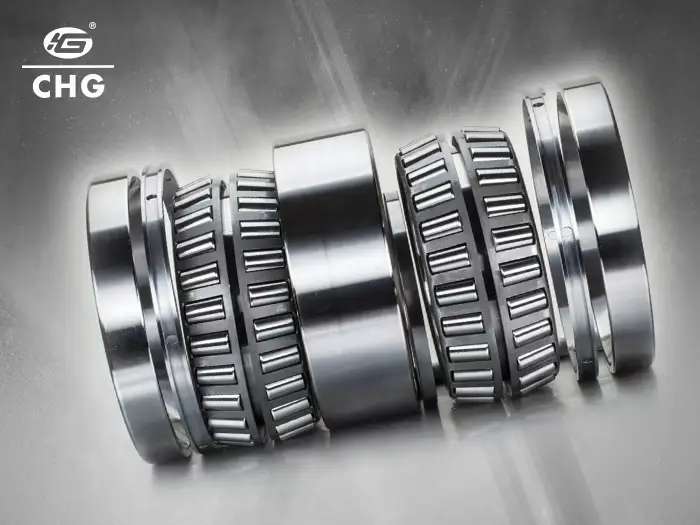
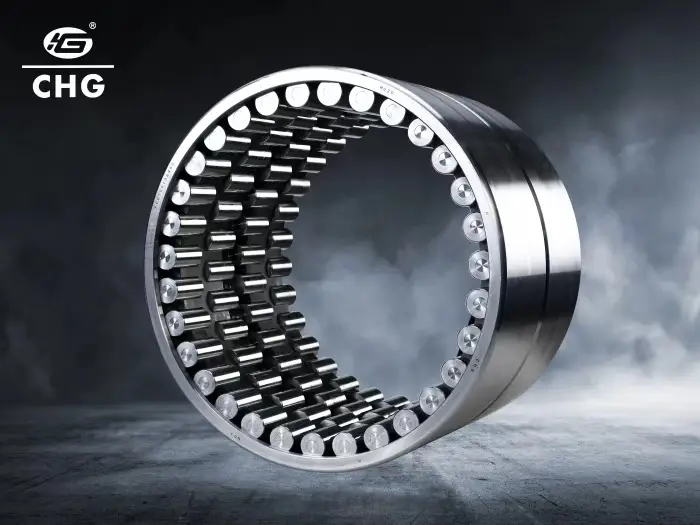
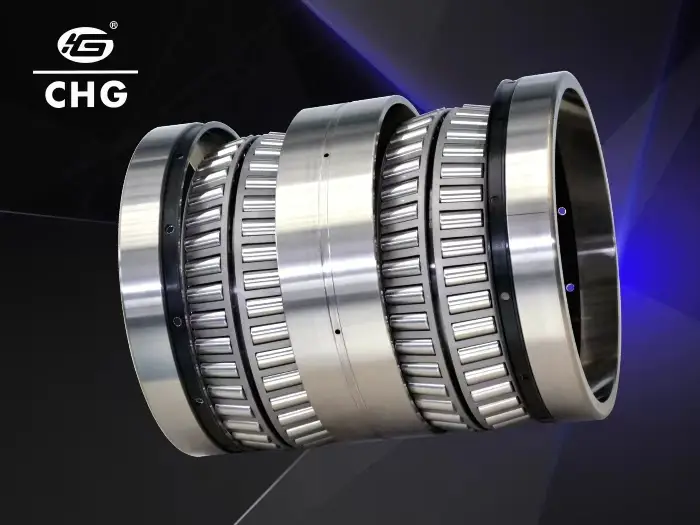
Mill bearings are not ordinary industrial bearings. Loading differs greatly among hot rolling, cold rolling, roughing, and finishing positions. Backup rolls on hot-rolling roughers carry very high radial loads and normally use four-row cylindrical roller bearings with separate thrust bearings for axial force. Cold mills require application-specific choices: high-speed thin-strip tandem mills and the work rolls of six-high or twenty-high mills use four-row cylindrical roller bearings with separate thrust bearings; older low-speed four-high cold mills and cold work rolls for medium and heavy plate often use four-row tapered roller bearings to carry combined radial and axial loads. Mill screwdown mechanisms mainly carry heavy unidirectional axial loads and should use full-complement tapered roller thrust bearings. Selection must begin by defining mill type, mounting position, load characteristics, and speed range before choosing the bearing design.
The Effects of Material and Heat Treatment on Life Are Often Underestimated
Bearings of the same designation can differ severalfold in actual service life because of material and heat treatment. Ring material: GCr15 bar is used under ordinary conditions. Forged GCr15 is preferred for heavy loads and significant impact, while cast ZGCr15 may be used for extra-large non-standard heavy-duty applications. Under severe impact, national-standard carburizing bearing steels such as 20CrNiMo, 20Cr2Ni4, and G20CrNi2Mo provide a hard surface and tough core for greater impact resistance.
Heat treatment: conventional quenching and tempering provide the baseline. Some premium mill bearings receive conventional cold treatment at -70°C to -80°C, controlling retained austenite to 5-10%. Deep cryogenic treatment in liquid nitrogen at -196°C generally reduces it below 3%, substantially improving dimensional stability and fatigue life.
Rolling-element accuracy: rolling elements in ordinary bearings are generally not sorted into matched groups. High-reliability ball bearings may use G10 or G5 balls; G10 sorting tolerance is approximately 0.5 μm, while G5 accuracy is better than 0.25 μm. Rollers for mill bearings follow dedicated roller-accuracy standards and do not use the G5/G10 classification applied to balls.
If bearings are replaced frequently or service life is inconsistent, verify that the selected material and heat treatment match the actual operating conditions.
Lubrication and Assembly Accuracy Directly Determine Actual Service Life
A significant proportion of premature bearing failures in the field result not from bearing quality but from improper lubrication or inadequate assembly accuracy.
Lubrication: mill bearings operate at high speed and heavy load. For open, unsealed bearings using grease, fill is generally 30-50% of internal free volume, using the lower end at high speed and the upper end for low-speed heavy loads. Fully sealed mill bearings are filled to 20-30%. Oil-air-lubricated bearings are generally supplied without prepacked grease. Oil-lubricated systems must maintain a continuous, stable film.
Assembly accuracy: after bearing clearance is adjusted, spacer thickness must be controlled rigorously; otherwise, the bearing may bind or develop excessive axial movement.
Factory inspection: bearing-forging material is ultrasonically tested for internal shrinkage cavities, laminations, and cracks. Finished rings are eddy-current tested for surface cracks and decarburization; ultrasonic testing is not repeated on finished products. Because replacement sites generally lack this inspection capability, they must rely on the supplier's quality controls.
When a bearing burns, becomes noisy, or shows similar problems, inspect lubrication and assembly first before changing to another bearing type.
Conclusion
Selecting a mill bearing is not about choosing the highest- or lowest-priced product; it is about finding the solution that best matches the operating conditions. Frequent thrust-bearing burn damage, inability to increase mill speed, and excessively short life can often be prevented through correct technical judgment at the selection stage.