
Bearing preload is a core precision-assembly process. By applying an axial or radial load to eliminate internal clearance, it optimizes contact between rolling elements and raceways. In industrial drives, particularly rolling-mill bearing systems, innovative spring-preload arrangements are driving technical advances. These solutions use elastic elements to provide dynamic preload and offer distinctive engineering benefits.
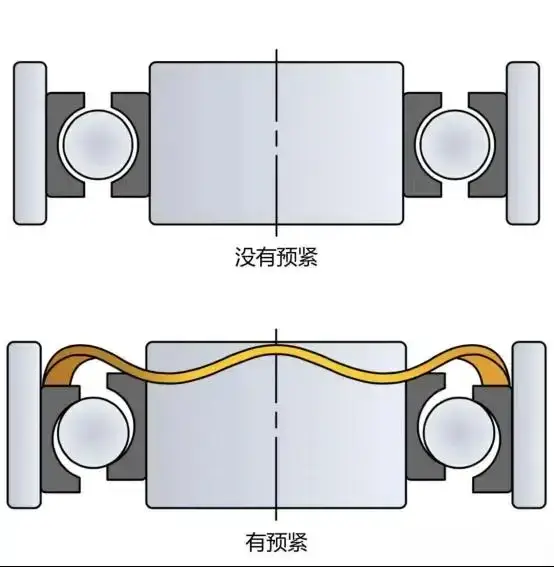
Analysis of Key Technical Advantages
Adaptive compensation: Through elastic deformation, a spring-preload system responds in real time to multiple operating variables. When rolling equipment experiences temperature fluctuations above 150°C, changes in spring modulus can automatically compensate for 0.02-0.05 mm of thermal displacement. Compared with conventional shim preload, axial positioning accuracy improves by more than 40%. This self-compensating capability is especially valuable on continuous casting and rolling lines, where it prevents uncontrolled clearance under alternating hot and cold conditions.
Vibration suppression: With a multistage spring-damping structure, the vibration velocity of a bearing system operating at 3,000 rpm can be reduced from 4.5 mm/s to 2.1 mm/s. Through phase cancellation, the spring elements attenuate 60% of high-frequency vibration energy in the 200-2,000 Hz range, a decisive benefit for surface-quality control in thin-strip rolling. In one cold-mill retrofit, strip-thickness tolerance improved from ±8 μm to ±3 μm after spring preload was introduced.
Extended service life: Dynamic preload equalizes contact-stress distribution across the raceway, extending calculated L10 life by 2.8 times under equivalent loading. Under the impact loads of a reversing mill, the spring-buffering structure reduces instantaneous overload peaks by 35%, addressing spalling caused by frequent reversals in conventional arrangements. At one steel plant's 1780 hot-strip mill, the bearing replacement interval increased from three months to eleven months.
Higher-speed capability: When linear speed exceeds 45 m/s, the flexible restraint provided by spring preload becomes particularly advantageous. Compared with hydraulic preload, frictional temperature rise is reduced by 18-22°C, effectively preventing cage welding. After spring preload was applied to the spindle bearing of an aluminum-foil mill, limiting speed increased from 8,500 rpm to 12,000 rpm and production capacity rose by 41%.
Engineering Challenges and Solutions
Space optimization: For compact mill housings, engineers developed an annular wave-spring assembly that reduces axial installation space by 40%. Finite-element topology optimization integrates 16 sets of asymmetric springs into a Φ320 mm bearing unit, tripling preload density.
Dynamic stability control: A smart spring using magnetorheological elastomer technology adjusts stiffness within 0.1 ms through an external control unit, successfully suppressing resonance during high-speed rolling. Tests show an amplitude-reduction rate of 92% under 50 Hz vibration disturbance.
Intelligent maintenance: Spring assemblies with integrated fiber-optic sensors can monitor preload decay and fatigue condition in real time. At one steel plant, the predictive-maintenance system reduced unplanned downtime by 78% and spare-parts inventory by 65%.
Economic assessment shows that although a spring-preload system initially costs 25-30% more than a conventional arrangement, total maintenance expenditure and downtime losses over the life cycle can be reduced by more than 55%. The technology is already used at scale in premium cold mills and nonferrous-metal rolling lines. As smart materials advance, it will continue to evolve toward miniaturization and self-adaptation. For modern rolling systems seeking greater productivity and product accuracy, spring preload has become an important means of strengthening core competitiveness.